Garage Door Safety and Security in San Antonio: Practical Tips to Protect Your Home and Family
With over two decades of combined industry experience, the team at Garage Doors 4 Less San Antonio has seen firsthand how overlooked garage door issues create real dangers for local families. Your garage door is the largest moving object in your home and one of the widest entry points on the entire property. That combination creates a dual challenge: preventing accidental injuries from a heavy, mechanized door and stopping unauthorized access from someone who knows how to exploit common weak points. According to the Texas Department of Public Safety’s annual crime data, property crime remains a persistent concern across Texas, and garages are frequently targeted because they often contain vehicles, tools, and a direct path into the home. Understanding both the safety side and the security side puts San Antonio homeowners in a much stronger position to protect their families and belongings.
Estimated reading time: 5 minutes
Key Takeaways
- The emergency release cord is the number-one method intruders use to defeat a closed garage door from the outside.
- Rolling-code opener technology prevents thieves from capturing and replaying your remote signal.
- Monthly auto-reverse and sensor testing is critical for child safety and overall system reliability.
- A malfunctioning door that does not close flush is both a safety hazard and a security vulnerability.
- The interior door between your garage and home should be treated like an exterior entry with a solid-core door and deadbolt.
- Smart garage features like auto-close timers and smartphone alerts address the most common failure: human forgetfulness.
- An annual professional inspection catches overlapping safety and security problems before they escalate.
Table of Contents
+
- How Do Burglars Actually Get Into a Garage?
- What Makes a Secure Garage Door in San Antonio?
- Practical Safety Tips Every San Antonio Family Should Follow
- The Door Between the Garage and the House
- Do Smart Garage Features Actually Improve Security?
- How Safety Problems Become Security Risks
- Securing Garage Windows and Side Access
- What to Do Before Leaving Town
- Safety Tips for Families with Children
- When to Call a Professional
- Frequently Asked Questions
- About the Author
How Do Burglars Actually Get Into a Garage?
Most garage break-ins are not dramatic forced entries. They rely on small oversights that many homeowners never think about. A thief may walk up a driveway, slide a thin tool under the bottom seal, hook the emergency release cord, and lift the door by hand in under ten seconds. Others simply check car doors for unlocked vehicles with a clipped-on remote opener sitting on the visor. In neighborhoods where garage doors remain open during errands or yard work, an opportunistic intruder can walk in unnoticed.
The Emergency Release Weak Point
The emergency release cord is an essential safety mechanism. It lets you open the door manually during a power outage or mechanical failure. However, this same cord is the number-one method intruders use to defeat a closed garage door from the outside. A coat hanger or hooked wire threaded through a gap near the top panel can snag the handle and disengage the opener. Shielding the cord with a simple zip-tie release blocker or a commercially available emergency-release lock helps deter this tactic while still allowing interior access in a real emergency.
An experienced intruder can exploit an unprotected emergency release cord and open a closed garage door in as little as six seconds using nothing more than a bent coat hanger. A two-dollar zip tie on the release handle can block this technique entirely.
Remote and Vehicle Access
Leaving a garage door remote clipped to your car visor is essentially leaving a key to your house in plain sight. The Texas DPS advises against storing valuables or access devices in vehicles, especially those parked in driveways or open lots. If someone gains entry to your car, the remote leads straight to your garage and, from there, into your home. A keychain-sized remote kept on your person or a smartphone-controlled opener eliminates this risk entirely.
Replace your visor-clipped remote with a keychain model you carry with you, or upgrade to a smartphone-controlled opener. Never leave any garage access device in an unattended vehicle, especially overnight.
Concerned about your garage door security? Our San Antonio technicians identify and fix vulnerabilities in a single visit.
What Makes a Secure Garage Door in San Antonio?
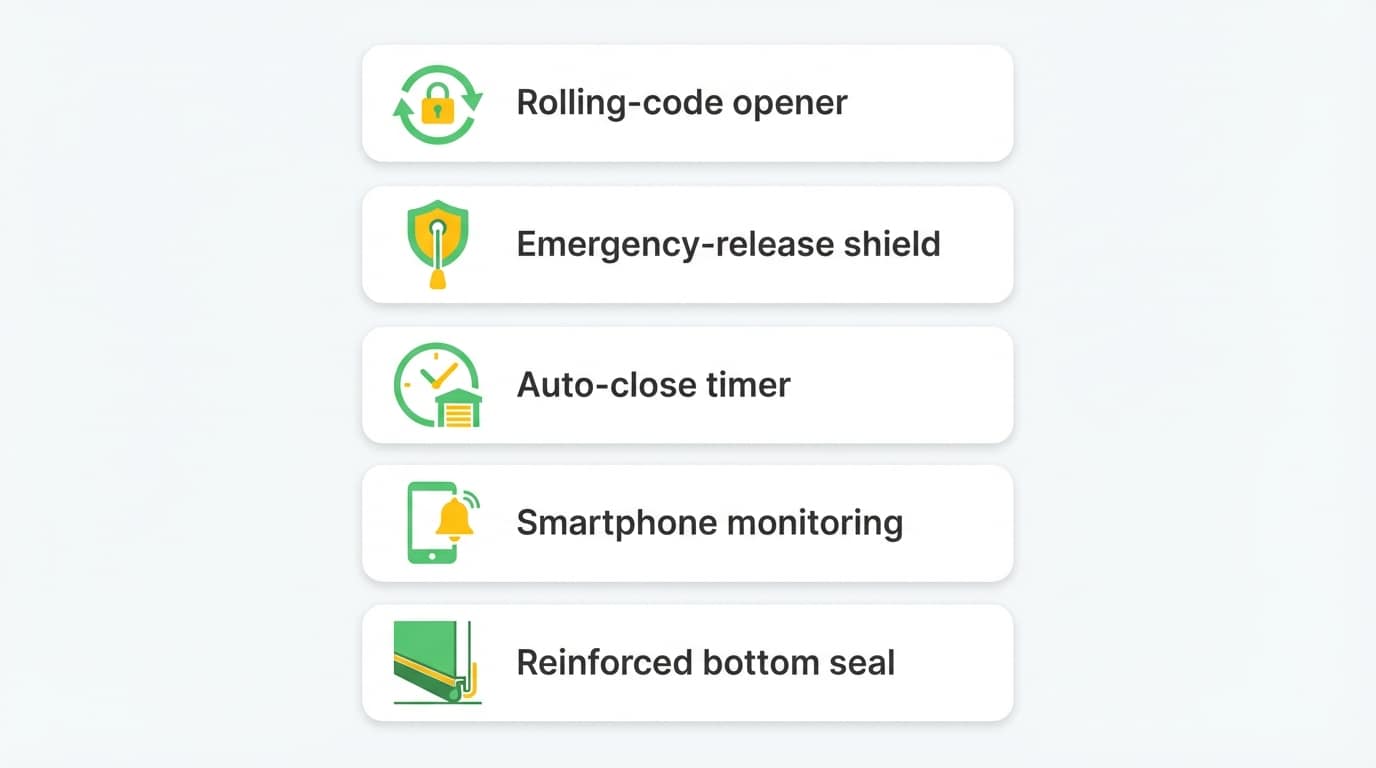
A secure garage door combines solid physical construction with updated technology. Older single-layer steel doors flex more easily under force, and outdated openers may use fixed radio codes that can be captured and replayed. Modern openers use rolling-code encryption, meaning every button press generates a unique signal that cannot be duplicated. Pairing that with a well-insulated, reinforced door panel dramatically reduces both forced-entry risk and everyday vulnerability.
If your opener is behaving erratically, failing to respond to the remote, or operating inconsistently, the security of the entire system is compromised. Seeking professional garage door opener repair ensures the motor, receiver, and code system are functioning correctly so the door responds only to authorized signals.
| Security Feature | What It Does | Why It Matters |
|---|---|---|
| Rolling-code opener | Generates a new access code with every use | Prevents code-grabbing by thieves with scanners |
| Emergency-release shield | Blocks external access to the release cord | Stops the most common manual break-in method |
| Auto-close timer | Shuts the door after a set period if left open | Eliminates the “forgot to close it” scenario |
| Smartphone monitoring | Sends alerts when the door opens or stays open | Provides real-time awareness even when away |
| Reinforced bottom seal | Closes the gap between door and floor | Prevents fishing tools from reaching internal hardware |
Practical Safety Tips Every San Antonio Family Should Follow
Safety and security overlap more than most people think. A garage door that does not reverse when it contacts an obstacle is both a physical danger and a sign that the system is not performing reliably. Federal standards enforced through the U.S. Consumer Product Safety Commission require every automatic residential garage door opener manufactured after 1993 to include an auto-reverse mechanism and photoelectric sensors that stop the door if anything breaks the beam near the floor.
To test your system at home, try the bucket test. Place a flat two-by-four board or a sturdy bucket on the ground in the door’s path and press the close button. The door should contact the object and immediately reverse. If it does not, stop using the opener until the issue is resolved. Published medical research has documented serious child injuries and fatalities involving openers that failed to reverse under conditions simulating a child’s body weight. This is not a check to postpone.
Children should never play near or under a moving garage door, and remote controls should be kept out of their reach. Teach every family member that the door is heavy equipment, not a toy, and that running under a closing door is never safe regardless of how responsive the sensors appear to be.
Place a two-by-four flat on the ground in the door’s path and press close. The door must reverse immediately on contact. If it does not, discontinue use and schedule a professional garage door repair inspection right away.
Maintenance Habits That Protect Your Home
A short monthly visual inspection catches problems before they escalate. Look at the cables on both sides of the door for fraying or loose strands. Check the springs above the door for visible rust, gaps, or deformation. Observe whether the door closes flush to the ground with no daylight gaps along the bottom or sides. Gaps not only let weather in; they also create openings that can be exploited with fishing tools to reach the emergency release.
Springs and cables are under extreme tension. If you notice any damage, do not attempt to adjust or replace these components yourself. Contact a technician for professional garage door repair in San Antonio to handle high-tension parts safely and restore proper balance to the door.
A Common Mistake: Ignoring the Door Between the Garage and the House
Many San Antonio homes have an attached garage with an interior door leading directly into the kitchen, hallway, or laundry room. Homeowners often treat this door casually, leaving it unlocked or using a flimsy hollow-core model with a basic knob lock. In reality, if someone breaches the garage door, this interior door is the last barrier between an intruder and your living space.
Treat it like an exterior door. Install a solid-core door with a quality deadbolt. Make sure the door frame is sturdy and that the strike plate is secured with three-inch screws that reach the wall studs.
The U.S. Department of Energy warns that attached garages can introduce carbon monoxide and chemical fumes into living spaces. Proper weatherstripping and a tight seal around the interior garage door protect both indoor air quality and energy efficiency, especially during San Antonio’s long, hot summers.
Beyond security, a well-sealed interior door reduces energy costs by preventing conditioned air from escaping into an unconditioned garage space. This is especially important in San Antonio where summer temperatures routinely exceed 100 degrees.
Limited appointments available this week. Schedule your free garage door safety and security inspection before slots fill up.
Do Smart Garage Features Actually Improve Security?
Smart garage door technology is not just a convenience upgrade. When used consistently, it addresses one of the most common security failures: human forgetfulness. A Wi-Fi-enabled opener can send a push notification to your phone if the door has been open for more than a set number of minutes. Some systems offer automatic closing after a timer expires, and many allow you to open or close the door remotely from anywhere.
Activity logs let you see exactly when the door was opened and closed, which is useful for households where multiple family members or service providers need access. Guest codes and scheduled access windows add another layer of control. That said, smart features work best as an addition to strong physical security, not a replacement. A smartphone alert means nothing if the door itself is flimsy, the springs are broken, or the emergency release is unprotected.
A smart opener with auto-close and alerts is powerful, but only when the door itself is in solid working condition. Always address mechanical issues first, then layer smart features on top for maximum protection.
How Safety Problems Quietly Become Security Risks

A garage door that shudders, hesitates, or does not close completely is not just annoying. It is a vulnerability. When a door does not seat firmly against the floor, tools can be inserted underneath. When tracks are bent or rollers are worn, the door may be easier to force off its rails. When an opener motor is failing, the locking mechanism may not engage properly after the door closes.
| Warning Sign | Safety Concern | Security Concern |
|---|---|---|
| Door does not close all the way | Risk of falling or sudden movement | Gap allows access to release cord |
| Grinding or scraping noise | Indicates worn rollers or bent track | Door may be easier to force open |
| Slow or jerky movement | Spring or cable tension issue | Locking mechanism may not engage |
| Sensors not responding | Door will not auto-reverse on contact | System may not detect tampering |
| Visible rust on springs | Increased risk of spring failure | Weakened structure overall |
This is where Garage Doors 4 Less San Antonio provides real value to local homeowners. A professional inspection identifies these overlapping risks early. Technicians can assess spring tension, track alignment, sensor calibration, and seal integrity in a single visit, resolving safety hazards and closing security gaps at the same time.
A standard residential garage door weighs between 130 and 350 pounds depending on size and material. When springs fail on a door that heavy, it can slam shut with enough force to cause serious injury or structural damage to the door and tracks.
Securing Garage Windows and Side Access Without Blocking All Light
Garage windows offer natural light and ventilation, but they also let people see what is stored inside and can serve as a secondary entry point. Frosted film or translucent panels let light in while blocking the view. Reinforced glass or polycarbonate panels are much harder to break than standard single-pane glass.
Side doors on detached garages deserve the same attention as the main garage door. A solid door, a quality deadbolt, and adequate exterior lighting make a significant difference. Motion-activated lights are especially effective because they draw attention to anyone approaching the area at night. Keep landscaping trimmed near garage access points so there are no hiding spots close to entry doors or windows.
What Should You Do Before Leaving Town?
Traveling creates a window of opportunity for garage-targeted theft. Before a trip, verify that the garage door closes completely and locks. Remove any remote openers from vehicles that will be parked outside. If your opener has a vacation mode or a wall-mounted lock switch, activate it. This physically disengages the remote receiver so the door cannot be opened with a signal.
Make sure the interior door between the garage and the house is locked. Set outdoor lights on a timer or use smart bulbs to simulate normal activity. If you have a smart opener, use the app to monitor status while you are away. These simple steps take a few minutes but dramatically reduce risk during an extended absence.
Most modern openers have a vacation lock switch on the wall-mounted control panel. Flipping this switch disables all remote signals, making the door openable only from inside the garage. It takes two seconds and adds a significant layer of protection.
Is your garage door closing properly, reversing on contact, and locking securely? If you are not sure, we will check it for free.
Garage Door Safety Tips for San Antonio Families with Children
Young children are naturally curious, and a moving garage door can be fascinating to watch. Establish firm household rules: no one runs under a closing door, remotes are not toys, and children do not play in the garage without adult supervision. Mount the wall button at least five feet from the floor so small children cannot reach it.
Test the auto-reverse and sensor systems monthly. Watch for any delay or hesitation in the reversal. If the door does not respond immediately when the sensor beam is broken, schedule service before using it again. At Garage Doors 4 Less San Antonio, technicians calibrate sensors to meet current federal UL 325 standards, ensuring the safest possible response time for every cycle.
When Is It Time to Call a Professional for a Safety and Security Check?
Good habits handle a lot of the daily risk, but the mechanical side of garage door safety requires trained hands and proper tools. If your garage door is more than ten to fifteen years old, the opener predates rolling-code technology, the springs show wear, or the door has taken an impact, a professional evaluation makes sense. Likewise, any time the door behaves unpredictably, makes new sounds, or fails to close flush, waiting only increases the chance that a small issue becomes a larger repair or a real security gap.
Garage Doors 4 Less San Antonio works with homeowners across the city to inspect, diagnose, and resolve the kinds of problems that affect both safety and security. From spring and cable condition to opener performance and sensor accuracy, a thorough check covers every component that keeps your family safe and your home protected. Whether you need garage door installation or a comprehensive repair, the company’s local presence means faster response times and familiarity with the specific door styles, weather conditions, and construction common in San Antonio neighborhoods.
What San Antonio Homeowners Say
“San Antonio Garage Doors 4 Less Inc. provided me with excellent quality garage door components when I needed them.”
Robert Adams
“My garage door spring gave out this week. The customer service was great.”
Marzella Voeun
“Installed my garage door in less than what was quoted and have been nothing but satisfied.”
Chris Moreno
“We’re so pleased with how our experience went with San Antonio Garage Doors 4 Less!”
Ora Garza
Source: Google Business Reviews
Frequently Asked Questions
+
Place an object like a cardboard box in the door’s path and press the close button. The door should reverse immediately upon contacting the object or when the sensor beam is interrupted. If it does not reverse, stop using the door and have the sensors inspected.
+
No. The emergency release is a federally required safety feature that allows manual operation during power outages or mechanical failures. Instead of removing it, install a release-cord shield that blocks external access while preserving interior functionality.
+
An annual professional inspection is a good baseline. If the door is used heavily, shows signs of wear, or is older than ten years, more frequent checks help catch problems before they escalate into safety or security issues.
+
Yes. Bent or warped panels can prevent the door from seating flush against the frame and floor, creating gaps that intruders can exploit. Damage can also affect track alignment, making the door easier to force off its rails.
+
Rolling-code openers generate a new encrypted signal each time you press the remote button. This prevents thieves from using devices that capture and replay a fixed radio signal to open your door. Most modern openers include this feature, but older units may not.
+
Absolutely. A side or service door with only a basic knob lock provides minimal resistance. A high-quality deadbolt with a reinforced strike plate significantly increases the effort required to force the door open.
+
Yes. Services range from spring and cable repair to opener replacement, sensor calibration, and overall door assessment. A single visit can address mechanical safety concerns and improve security features at the same time. Visit our services page for a full list of what we offer.
Ready to strengthen your garage door safety and security? San Antonio homeowners trust Garage Doors 4 Less for fast, professional inspections and repairs.