Your garage door is likely the largest moving object in your home — cycling over a thousand times per year, shielding vehicles, tools, and often serving as your family’s main entry point. In San Antonio, where brutal summer heat regularly exceeds 100°F and sudden winter freezes can drop temperatures by 40 degrees overnight, every spring, cable, roller, and panel endures relentless stress. When something finally gives way, the inconvenience is immediate, the security risk is real, and the safety danger can be serious. This guide walks you through everything San Antonio homeowners need to know about identifying problems early, understanding when professional help is essential, and making smart decisions about repair versus replacement — so you can keep your garage door working safely and reliably year-round.
Key Takeaways
- Garage doors rarely fail without warning — grinding noises, uneven movement, and blinking opener lights are early signs that demand attention.
- DIY spring repair is genuinely dangerous: peer-reviewed medical research documents severe, life-altering injuries from amateur attempts.
- Repair makes sense for isolated failures on newer doors; replacement is smarter when accumulated repair costs approach 50% of a new door’s price.
- San Antonio’s extreme heat, rapid temperature swings, and high humidity accelerate wear on springs, tracks, and weatherstripping.
- Monthly safety checks recommended by DASMA take minutes and can prevent entrapment injuries, especially for households with children.
- Delaying repairs increases total cost, compromises home security, and may affect homeowner insurance coverage.
What Symptoms Tell You Something Is Wrong With Your Garage Door?
A garage door rarely fails without warning. In most cases, the signs show up days or even weeks before the door stops working entirely. Recognizing those signs early can save you money and prevent a minor issue from turning into a dangerous situation. Here are the most common symptoms San Antonio homeowners report before calling for service.
Grinding or scraping noises typically point to worn rollers or debris in the tracks. A door that moves unevenly — rising faster on one side — often indicates a broken or weakened spring. If your door reverses immediately after touching the floor, the close-limit setting on the opener may need adjustment, or the safety sensors could be misaligned. A door that refuses to close at all, with the opener light blinking, almost always means the photo-eye sensors are blocked or out of alignment.
Federal safety rules administered by the U.S. Consumer Product Safety Commission require all automatic garage door openers to include entrapment protection that meets UL 325 safety standards. These systems are designed to reverse the door within two seconds of contacting an obstruction. When those systems malfunction, the door may behave unpredictably — staying open, refusing to close, or reversing without any visible cause.
A Scenario Every San Antonio Homeowner Should Prepare For
Picture this: it is a Monday morning, you are running late for work, and you press the button on your remote. The opener hums, but the door does not move. You try the wall switch — same result. The motor runs, yet the door stays put. This usually means the drive mechanism has disconnected from the door, or a spring has broken overnight, leaving the door too heavy for the opener to lift.
In San Antonio’s heat, a garage that cannot be secured is more than an inconvenience. It is an open invitation for theft and a potential safety hazard if pets or children can access the street. Knowing who to call before this happens — and understanding what the repair involves — takes the panic out of the situation.
⚠️ Don’t wait for a Monday morning surprise. Schedule a preventive inspection today.
How Dangerous Is It to Repair Garage Door Springs Yourself?
This is not a scare tactic. The medical evidence is clear. A case series published in a peer-reviewed ophthalmology journal documented multiple patients who suffered severe open-globe eye injuries from garage door springs that released during amateur repair attempts. These are life-altering injuries caused by a single moment of miscalculation.
Garage door torsion springs store an enormous amount of energy. When one breaks, it can spin violently on the shaft. When someone without training tries to wind or unwind these springs using improvised tools, the result can be catastrophic. The Door and Access Systems Manufacturers Association explicitly states that springs, cables, brackets, and bottom fixtures should only be adjusted by trained service technicians with proper equipment.
If you hear a loud bang from your garage and the door suddenly feels impossibly heavy, that is almost certainly a broken spring. Do not attempt to open or close the door manually. Instead, contact a professional who handles garage door spring replacement with the right tools and safety protocols.
Comparing Repair Versus Replacement: Which Makes Financial Sense?
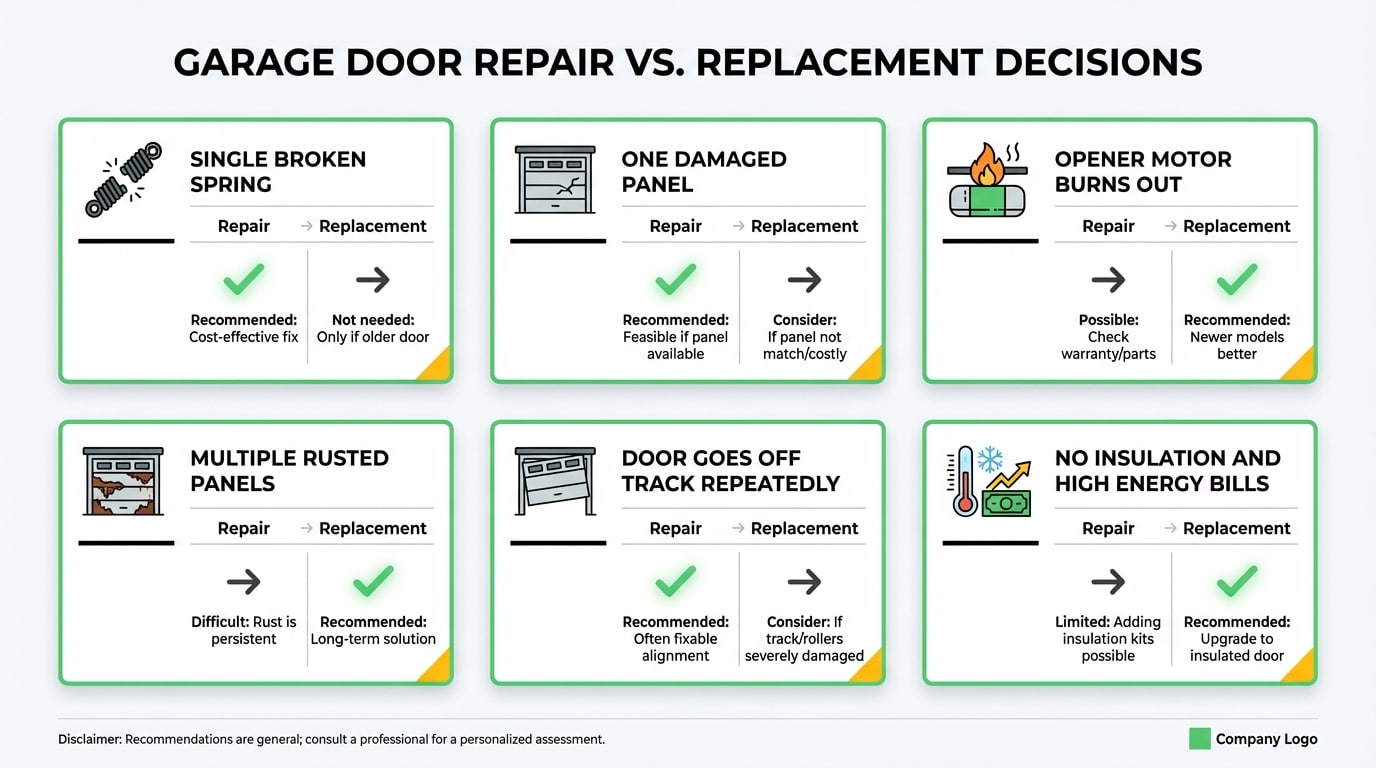
Not every broken garage door needs to be replaced entirely, and not every old door is worth repairing. The decision depends on several specific factors. The following table breaks down common situations and the most practical path forward.
| Situation | Repair Usually Makes Sense | Replacement May Be Smarter |
|---|---|---|
| Single broken spring on a door less than 10 years old | Yes — springs are a normal wear item | No, unless multiple other components are failing |
| One damaged panel from a vehicle impact | Yes — if the same panel style is still available | Consider it if panels are discontinued or door is warped |
| Opener motor burns out | Yes — opener replacement is straightforward | Only if the door itself is also near end of life |
| Multiple rusted panels and sagging sections | Rarely cost-effective | Yes — a new door improves security, curb appeal, and efficiency |
| Door goes off track repeatedly | Only if track can be realigned and hardware is sound | Yes — recurring derailment suggests structural issues |
| No insulation and high energy bills from attached garage | Adding weatherstripping may help slightly | Yes — an insulated door pays for itself over time |
When the cost of accumulated repairs approaches 50 percent of a new door’s price, replacement typically becomes the better investment. A new garage door also delivers one of the highest returns on investment of any home improvement project — a fact that matters if you are thinking about selling your San Antonio home in the coming years.
Five Mistakes Homeowners Make When a Garage Door Breaks
1. Forcing the door open manually without disengaging the opener. This can strip the drive gear or bend the track, turning a simple repair into a much more expensive one.
2. Ignoring a noisy door for months. Grinding, squealing, and popping sounds are early warnings. Waiting until the door stops working entirely means the repair will likely involve more components and higher cost.
3. Lubricating the wrong parts with the wrong product. WD-40 is a solvent, not a long-term lubricant. Using it on garage door springs or hinges can actually accelerate wear. A silicone-based or lithium-based garage door lubricant is what professionals recommend.
4. Adjusting spring tension without training. As covered above, this is a safety issue, not a skill issue. Even experienced DIY homeowners should leave spring work to professionals.
5. Hiring the first company that answers the phone without asking what is included. A proper repair quote should cover diagnosis, parts, labor, and a post-repair safety test. If a company cannot explain what you are paying for, that is a red flag.
What Should a Professional Garage Door Service Appointment Include?
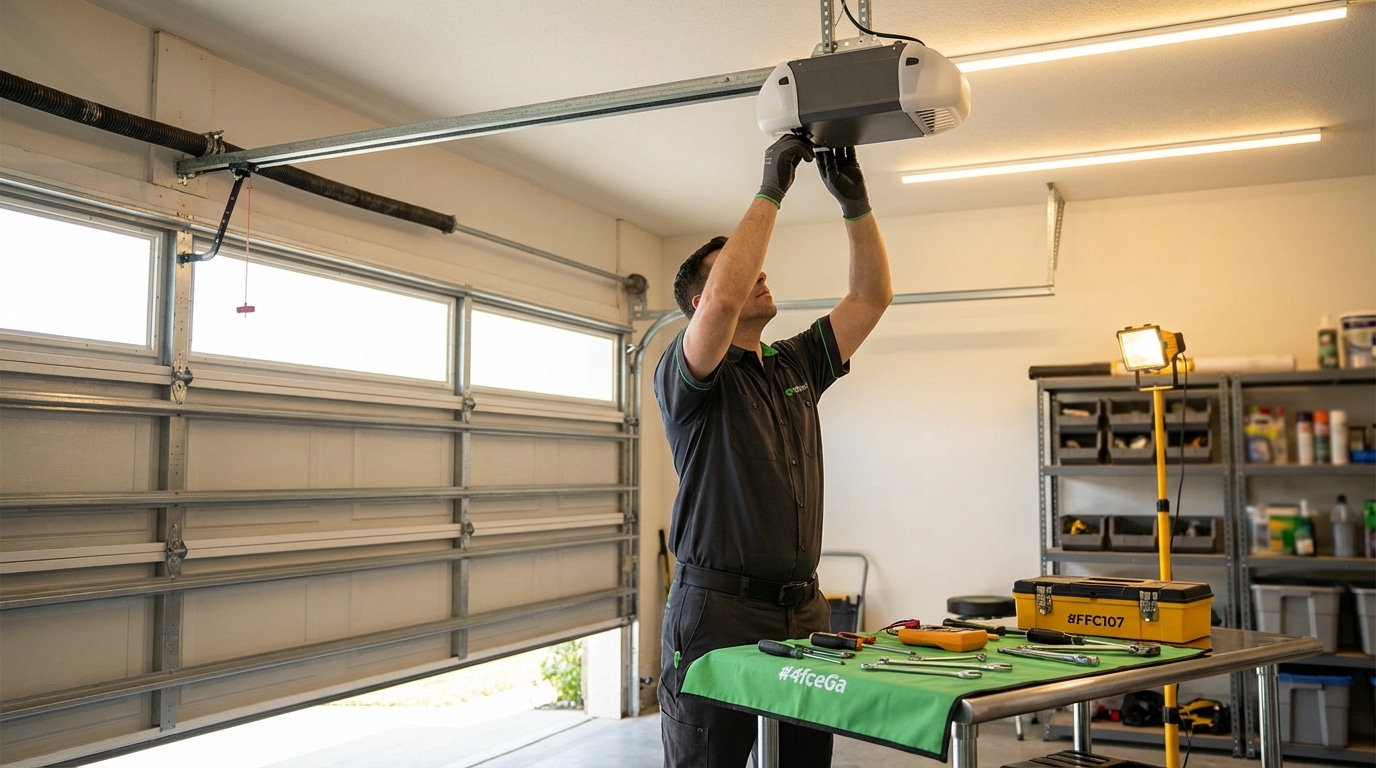
A thorough service visit goes well beyond swapping out a broken part. Here is what a complete appointment looks like when handled by an experienced technician in San Antonio.
The process begins with a full visual inspection — tracks, rollers, springs, cables, hinges, weatherstripping, and the opener system. The technician checks the door’s balance by disconnecting the opener and lifting the door manually to the halfway point. A properly balanced door should stay in place. If it falls or rises, the spring tension needs adjustment.
After diagnosis, the technician explains the issue and outlines repair options, including which parts need replacement and why. Once the repair is completed, the door is tested through several full open-close cycles. Safety sensors are verified, the auto-reverse function is checked, and the opener’s force settings are confirmed. Lubrication is applied to all moving parts, and the technician may point out areas that will need attention in the near future.
Garage Doors 4 Less San Antonio structures its service appointments to cover each of these steps so that homeowners understand exactly what was done and what condition their door is in. That transparency helps homeowners plan ahead rather than react to the next breakdown.
“The technician showed me exactly what was wrong before starting any work. No surprises on the bill, and the door has been running perfectly for months.” — Verified San Antonio Homeowner
How Do Monthly Safety Tests Protect Your Family?
The Door and Access Systems Manufacturers Association recommends that homeowners perform a simple monthly safety check and schedule professional service at least once a year. These checks are straightforward and take only a few minutes.
Start by placing a 2×4 flat on the ground in the door’s path. Close the door using the opener. When the door contacts the board, it should reverse immediately. If it does not, the opener’s force or travel settings may need adjustment — or the safety system may be failing. This test directly addresses the entrapment risk that federal safety standards were designed to prevent. A 1996 study published in Pediatrics found that automatic garage door openers posed a serious risk of severe injury or death to children, particularly when reversal mechanisms were not functioning correctly.
Next, test the photo-eye sensors by waving an object — like a broom handle — through the beam while the door is closing. The door should reverse or stop. If it does not, the sensors may be misaligned, dirty, or damaged. Finally, visually inspect cables for fraying, springs for gaps or elongation, and tracks for dents or debris.
What San Antonio Weather Does to Your Garage Door Over Time
San Antonio’s climate is uniquely hard on garage doors. Summer temperatures regularly exceed 100°F, heating metal components and causing expansion. Steel tracks can warp slightly. Lubricant dries out faster. Rubber weatherstripping cracks and hardens. Then a winter cold snap arrives — sometimes dropping temperatures by 40 degrees in a single day — and metal contracts, springs lose flexibility, and components that were already marginal can fail.
Humidity is another factor. San Antonio’s average relative humidity hovers around 65 to 70 percent for much of the year. This accelerates rust on springs, hinges, and exposed hardware, especially on doors facing east or south where moisture collects overnight. Regular lubrication and periodic hardware inspection are not optional in this climate — they are essential to avoid premature failure.
🔴 San Antonio’s peak summer heat accelerates garage door component failure. If your door hasn’t been serviced this year, spring breakdowns and cable failures are significantly more likely during the hottest months. Schedule your tune-up before the rush.
Local Regulations and Safety Rules That Apply in Bexar County
Texas has specific guidelines that affect garage door work. According to the Texas Department of Public Safety, installing a garage door opener does not typically require a security-related license for residential work, but professional standards still apply when it comes to electrical connections and safety system calibration. For homeowners in unincorporated Bexar County, major structural modifications to a garage — such as widening an opening or adding a new door — may require a building permit from the county.
Carbon monoxide safety is another local concern that gets overlooked. The EPA warns that running a vehicle inside an attached garage, even with the door open, can allow dangerous CO levels to build up inside the home. This is especially relevant during San Antonio’s occasional ice storms, when homeowners may idle vehicles in the garage for warmth. A properly sealed garage door with intact weatherstripping helps limit air exchange between the garage and living space — but it is never a substitute for a working CO alarm.
For homeowners considering garage door opener repair and installation, working with a local team that understands both the technical requirements and the regional context ensures the job meets applicable standards from the start.
How Garage Doors 4 Less San Antonio Addresses Common Homeowner Needs
| Common Homeowner Need | How the Service Helps in Practice |
|---|---|
| Door stopped working and needs same-day attention | Local San Antonio team means shorter response windows and familiarity with common door brands installed in the area |
| Unclear what is wrong — need honest diagnosis | On-site inspection with explanation before any work begins, so homeowners understand the issue and options |
| Concern about safety during spring or cable repair | Technicians carry the right tools and follow industry safety protocols for high-tension components |
| Want to maintain the door to avoid future breakdowns | Tune-up service that includes lubrication, balance check, hardware tightening, and safety testing |
| Need to decide between repairing and replacing | Straightforward assessment based on door condition, age, and cost comparison — not a push toward the more expensive option |
One thing homeowners in San Antonio consistently appreciate is getting clear information before committing to a repair. Garage Doors 4 Less San Antonio builds its service process around that transparency — showing what is broken, explaining why, and letting the homeowner make an informed decision. That approach works especially well for first-time homeowners who may not know the difference between a torsion spring and an extension spring, or why one type of roller lasts three times longer than another.
“As a first-time homeowner, I had no idea what was wrong with my garage door. They walked me through everything, showed me the broken spring, and gave me options without any pressure. Highly recommend for anyone in San Antonio.” — Verified Google Reviewer
What Determines How Long a Garage Door Repair Takes?
Most standard repairs — a single spring replacement, roller swap, or opener adjustment — take between one and three hours from arrival to completion. Several factors influence whether your repair falls on the shorter or longer end of that range.
The type of failure matters most. Replacing a pair of torsion springs on a standard residential door is a focused job that an experienced technician can complete efficiently. Repairing a door that has jumped off both tracks, however, requires careful realignment and inspection of multiple components before the door can be tested safely. Opener replacements tend to take longer because they involve mounting, wiring, programming remotes, and calibrating safety sensors.
Parts availability is the second factor. A local service provider that stocks common springs, rollers, cables, and opener parts on their trucks can finish the job in one visit. If a specialty part needs to be ordered — an unusual panel style or an older opener circuit board — a follow-up visit may be necessary.
Measurable Signs That Your Door Needs Immediate Attention
Not sure if your garage door problem is urgent or something that can wait? Here is a practical way to assess the situation based on what you can observe without touching any high-tension components.
| What You Observe | What It Likely Means | Urgency Level |
|---|---|---|
| Loud bang from garage, door will not lift | Broken torsion spring | High — do not operate the door |
| Door closes partway then reverses | Sensor misalignment or close-limit issue | Moderate — door is functional but not secure |
| Visible gap between cable and drum | Cable has slipped or partially snapped | High — door may fall unexpectedly |
| Door wobbles or shakes during movement | Worn rollers or bent track | Moderate — will worsen if ignored |
| Opener runs but door does not move | Stripped gear, broken chain, or disconnected trolley | Moderate to High — depends on cause |
| One side of the door hangs lower than the other | Spring imbalance or cable issue | High — strains opener and tracks |
If you observe any high-urgency sign, avoid using the door until a professional inspects it. Operating a door with a broken spring or loose cable can cause the door to drop suddenly, creating a serious injury risk.
🚨 Spotted a high-urgency sign? Same-day service is available for San Antonio homeowners.
Why Delaying Garage Door Repair Costs More in the Long Run
A squeaky roller costs a fraction of what a full track replacement costs after a damaged roller scores and bends the track. A worn cable that snaps under tension can send the door crashing down, damaging panels that were otherwise in good condition. And a misaligned sensor that keeps the door from closing leaves your garage — and everything in it — exposed overnight.
Beyond the direct repair costs, there are security and insurance implications. An unsecured garage in San Antonio is a common entry point for property theft. Some homeowner insurance policies may limit coverage for losses that occurred through an unsecured opening that the homeowner was aware of but did not address. Timely repair is not just about convenience — it protects your property and your coverage.
⏳ Every day you delay a garage door repair, the potential cost increases. A $150 roller replacement today can prevent a $600+ track repair next month. Don’t let a small fix become a big bill.
Frequently Asked Questions About Garage Door Repair in San Antonio
How much does a typical garage door repair cost in San Antonio?
Costs vary based on the type of repair. A spring replacement generally costs less than a full opener installation. The final price depends on parts, labor, the type and size of your door, and whether the service is scheduled or emergency. The most reliable way to get an accurate number is to request an on-site quote that itemizes each component.
Can I fix a garage door that went off track myself?
It is not recommended. A door that has come off the track is under uneven tension and can shift or fall without warning. Realigning it requires securing the door in place, relieving tension safely, and reseating the rollers in the correct position — a process that calls for professional tools and experience.
How do I know if the problem is my opener or the door itself?
Disconnect the opener by pulling the emergency release handle. Try lifting the door manually. If the door moves smoothly and stays in place halfway up, the door is likely fine and the opener is the issue. If the door is extremely heavy, drops immediately, or moves unevenly, the problem is with the door’s springs, cables, or hardware.
How often should I have my garage door professionally serviced?
Industry guidelines from DASMA recommend at least once a year. In San Antonio, where heat and humidity accelerate wear, scheduling a professional tune-up every 12 months helps catch issues before they lead to a breakdown.
Is it safe to be in the garage when the door is being repaired?
During high-tension work like spring or cable replacement, it is best to stay clear of the work area. A qualified technician will secure the door and manage the workspace. Once the repair is complete and tested, the garage is safe to use normally.
What should I do if my garage door will not close and I need to leave the house?
If the door will not close electronically, use the emergency release to switch to manual mode and pull the door down by hand. Lock it using the manual slide lock if your door has one. Then call for service so the issue is resolved before the end of the day.
Ready to Get Your San Antonio Garage Door Working Again?
Whether your door is making strange noises, refuses to open, or you just want a professional set of eyes on a system that has not been serviced in years — putting it off only increases the risk and the eventual cost. A single service call can identify what is wrong, get it fixed, and give you confidence that your garage door is operating safely.
What would it mean for your daily routine if your garage door worked smoothly and reliably every single time? If you are ready to find out, contact Garage Doors 4 Less San Antonio to request a quote or schedule a service appointment. Local expertise, honest diagnosis, and professional results — that is what a good garage door repair experience should look like.
Your Garage Door Won’t Fix Itself — But We Will.
San Antonio homeowners trust Garage Doors 4 Less for transparent pricing, same-day availability, and professional repairs done right the first time.
About the Author
The Garage Doors 4 Less San Antonio Team
With years of hands-on experience serving homeowners across San Antonio and Bexar County, the Garage Doors 4 Less team specializes in residential garage door repair, spring replacement, opener installation, and preventive maintenance. Every article is informed by real service calls, industry best practices, and a commitment to helping homeowners make safe, informed decisions about their garage doors. Learn more about our services.